Music Royalties Explained: The Ultimate Guide for Artists (2026)
If you're a songwriter, recording artist, or producer earning real money from your music, you deserve to collect every cent of your royalty income. But in the modern music business, tracking all the royalties generated from your copyrighted music across different formats, platforms, and countries can feel like a maze.
Welcome to the world of music royalties: a critical revenue stream for every working musician. And if you're starting to earn four figures or more per year from your songs, it's time to treat your royalties like a business. Because they are.
At KOSIGN, powered by Kobalt, we give artists the power to unlock their full royalty stream. Backed by the most advanced publishing administration technology in the music industry, we make it simple, transparent, and fast to collect what you’re owed. No guesswork. No middlemen. No getting buried under the red tape of record companies or societies.
In this comprehensive guide, we'll break down exactly how music royalties work, which types apply to your songs, who pays you, and how to finally get clarity around your income.
What Are Music Royalties?
Music royalties are payments made to rights holders when a musical work or sound recording is used, performed, streamed, or licensed. If you write, record, or produce music, you are likely entitled to multiple forms of royalty payments from a variety of sources.
The music industry has evolved beyond CDs and radio. Today, royalties are generated from digital streaming, on-demand streaming services, synchronization licensing, live performances, and even print music like sheet music. With so many ways your songs can earn, the system for collecting royalties has become more fragmented than ever.
But the good news? More formats mean more opportunities. And when you’re set up correctly, those pennies add up to serious money.
The Two Sides of Copyright: Master vs. Composition
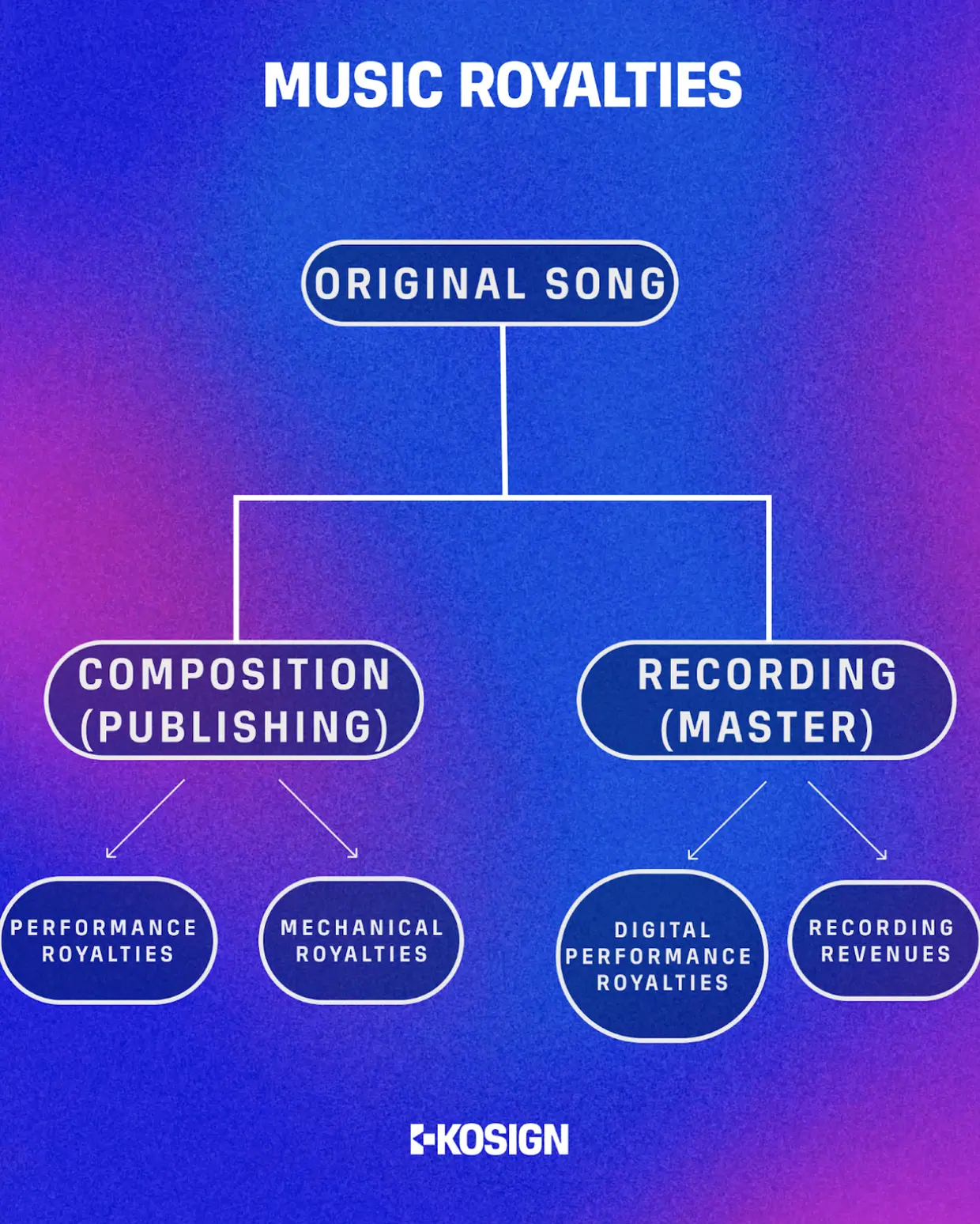
Under U.S. Copyright Law, every recorded song has two distinct copyrights attached to it, and understanding this split is the foundation of collecting all your royalties [1].
- The Composition (Publishing Rights): This copyright protects the underlying musical work itself—the melody, lyrics, and harmony. It belongs to the songwriters and their music publishers.
- The Sound Recording (Master Rights): This copyright protects a specific recorded version of a composition. It belongs to the recording artist and their record label (or whoever financed the recording).
This means every time a song is played, two sets of royalties are generated: one for the composition and one for the recording. If you are an independent artist who writes and records your own music, you own both copyrights and are owed both sets of royalties.
The 8 Types of Music Royalties You Must Collect
Let's break down the key royalty types that apply to most modern artists.
Publishing Royalties
These are earned by the composition copyright (songwriters and publishers).
1. Mechanical Royalties Generated when your composition is reproduced. This includes interactive streams (like on Spotify or Apple Music), digital downloads, vinyl pressings, and CDs. In the U.S., these are collected by the Mechanical Licensing Collective (MLC) for digital uses and agencies like the Harry Fox Agency (HFA) for physical products [2].
2. Performance Royalties Earned when your music is performed publicly. This includes radio play, TV broadcasts, live venues, restaurants, and even streaming services. These are collected by Performing Rights Organizations (PROs) like ASCAP, BMI, SESAC, and GMR in the U.S. [3].
3. Synchronization (Sync) Royalties Generated when your song is licensed for use in visual media, such as TV shows, films, commercials, or video games. These are negotiated directly with publishers and rights holders and can be a significant source of income.
4. Print Music Royalties Earned from the sale of sheet music, tablature, or lyric books. While smaller for most artists, it can be a steady income stream for certain genres.
Master Royalties
These are earned by the sound recording copyright (recording artists and labels).
5. Digital Performance Royalties (Master) These are generated when your sound recording is played on non-interactive digital services like Pandora, SiriusXM, and internet radio. In the U.S., these are collected exclusively by SoundExchange [4]. Crucially, these royalties are split between the master rights owner (50%), the featured artist (45%), and non-featured musicians/vocalists (5%).
6. Streaming Royalties (Master) These are the master-side royalties paid out by interactive streaming services like Spotify and Apple Music. They are typically paid to your digital distributor (like TuneCore or DistroKid), who then pays you.
7. Neighbouring Rights Royalties These are essentially the international version of digital performance royalties, but for a much broader range of uses, including terrestrial radio, TV, and public spaces in most countries outside the U.S. [5]. U.S.-based artists are often eligible for these royalties for plays in foreign territories.
8. Producer & Session Musician Royalties Producers and session musicians can be entitled to a portion of royalties, either through a share of the master rights (points) or via direct payments from organizations like SoundExchange for their contributions to a recording.
How Are Music Royalties Collected and Paid?
The flow of money in music royalties is complex, involving many different organizations. Here is a simplified overview:
- PROs (ASCAP, BMI, etc.): Collect performance royalties from thousands of venues, broadcasters, and digital services and pay them to songwriters and publishers.
- The MLC: Collects digital mechanical royalties from streaming services in the U.S. and pays them to publishers and self-published songwriters.
- SoundExchange: Collects digital performance royalties from non-interactive services and pays them to master owners and performers.
- Digital Distributors (TuneCore, CD Baby, etc.): Collect master-side streaming royalties from platforms like Spotify and pay them to independent artists.
- Publishing Administrators (like KOSIGN/Kobalt): Act as a global hub, registering your songs with all of these societies worldwide to ensure no money is left on the table.
How to Register and Collect All Your Royalties: A 4-Step Guide
To ensure you are collecting every royalty stream you are owed, you must register your works with several different organizations.
- Join a Performing Rights Organization (PRO): As a songwriter, you must join one PRO (e.g., ASCAP or BMI) to collect your share of performance royalties. You cannot join more than one as a writer.
- Register with The MLC: If you are a self-published songwriter, you must register with The MLC to collect your digital mechanical royalties in the U.S. It is free to join.
- Register with SoundExchange: As both a recording artist and a master rights owner, you must register with SoundExchange to collect your digital performance royalties for non-interactive streams.
- Use a Digital Distributor and Publishing Administrator: A distributor gets your music onto streaming platforms, and a publishing administrator like KOSIGN registers your compositions globally to collect all your publishing royalties from every source.
Common Ways Artists Miss Out on Royalties
Here are just a few scenarios we see all the time:
- You sign recording contracts but don’t understand the royalty rate splits on your master.
- You have multiple band members but only one person registered the song with a PRO.
- You uploaded your music to a distributor, but no one is administering your publishing rights globally.
- You get placements in syncs but don’t know that the publisher takes ownership of the backend royalties.
- You’re generating royalties internationally but have no direct collections setup in ex-US territories.
Sound familiar? This is why a modern, transparent admin solution matters more than ever.
Enter KOSIGN: A Modern Solution for Royalty Collection
KOSIGN, powered by Kobalt’s world-class technology, gives you access to the same admin system trusted by music legends, with the flexibility you need to stay in control [6].
We help artists, producers, and songwriters who are serious about their music—and their money—collect from all corners of the globe.
Here’s how we do it:
- Global Reach: Direct digital collections from over 200 territories, cutting out third-party fees and delays [7].
- Full Transparency: A clear view into your catalog, registrations, and royalty payments.
- Artist-Friendly Terms: A flat 80/20 deal in your favor with no lock-ins. You keep full ownership of your rights.
You get paid faster. You see exactly what you’re earning. And you never have to wonder if something slipped through the cracks.
Final Thoughts: Music Is More Than Art, It’s Your Business
In today’s music industry, artists can’t afford to stay in the dark. Your songs are your intellectual property, and your royalties are the return on your creative investment. KOSIGN is here to make sure you’re paid properly across all types of music, digital formats, and platforms.
If you’re ready to stop guessing and start collecting, we’re ready for you.
[Apply to KOSIGN now and take the guesswork out of your royalty income.](https://www.kosignmusic.com/apply)
Frequently Asked Questions (FAQ)
Q: What are mechanical royalties? A: Mechanical royalties are payments generated every time a musical composition is reproduced, whether as a physical copy (like a CD or vinyl record) or a digital copy (like a stream or download).
Q: How do I collect performance royalties? A: To collect performance royalties, you must be registered as a songwriter with a Performing Rights Organization (PRO) like ASCAP, BMI, or SESAC.
Q: Do I need a publisher to collect royalties? A: While you can register with many societies on your own, a publishing administrator like KOSIGN is essential for collecting royalties globally from hundreds of sources that are inaccessible to individual songwriters.
Q: What is the difference between SoundExchange and a PRO like ASCAP? A: SoundExchange collects royalties for the sound recording from non-interactive digital services. A PRO collects royalties for the composition from a wide range of public performances (radio, TV, venues, streaming).