KOSIGN vs. SoundExchange: Understanding the Differences in Music Royalties
KOSIGN vs. SoundExchange: Understanding the Differences in Music Royalties
In today's music industry, knowing where your royalties come from and who's actually responsible for collecting them is essential. If you're a songwriter, producer, or artist, you've likely come across both KOSIGN and SoundExchange. While both play critical roles in helping songwriters get paid, they handle completely different sides of the royalty equation.
Here's what you need to know.
What Is SoundExchange?
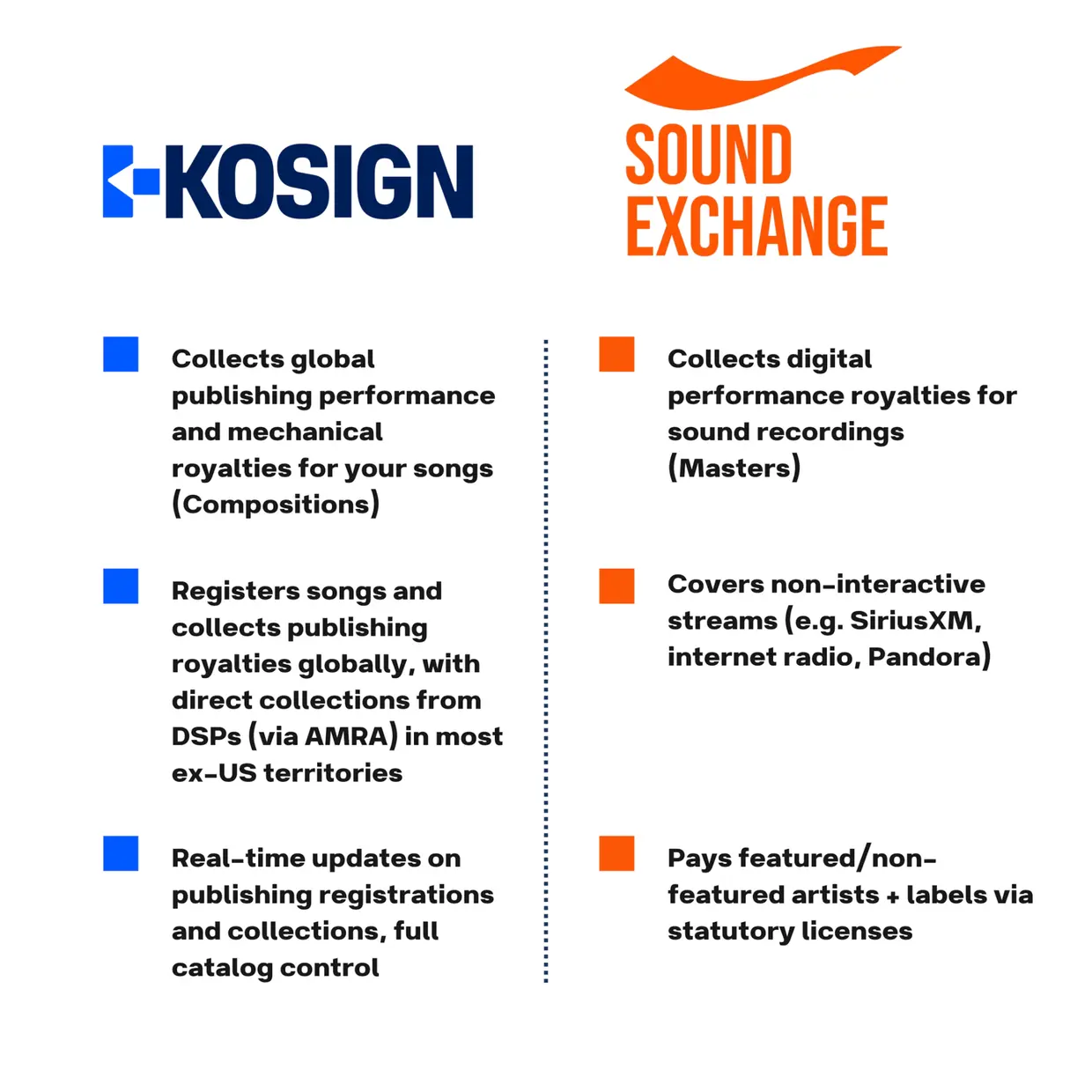
SoundExchange is the sole organization designated by the U.S. Copyright Office to collect and distribute digital performance royalties for copyrighted sound recordings. These royalties are generated when recordings are played on non-interactive digital audio transmissions, like satellite music services (such as SiriusXM), internet radio, and streaming musical content on platforms that use automatic licenses.
SoundExchange collects royalties and pays performance royalties to featured artists, non-featured artists, record labels, and other rights owners tied to the sound recording itself. These digital royalties are governed by statutory licenses set by the Copyright Royalty Board, which means the rates and rules are regulated, not negotiated.
They also maintain a copyright database to help match usage to rightful owners, and SoundExchange Direct is their free tool that allows rights holders to submit ownership claims and manage payouts.
But - and this is important - SoundExchange only covers the recording side. If you write or co-write music, you're missing out on an entire layer of royalty income if you stop there.
What Is KOSIGN?
KOSIGN is a flexible publishing admin platform powered by Kobalt. It's built specifically for independent artists, producers, and songwriters looking to collect their global publishing royalties. KOSIGN helps songwriters collect the other side of the royalty picture - the composition side - using proprietary music tech solutions and a global infrastructure.
When your music streams or plays, two copyrights are involved: one for the sound recording, and one for the underlying composition. SoundExchange handles one. KOSIGN handles the other.
KOSIGN collects all mechanical and performance royalties from the composition side. The platform uses music data exchange tools to track your earnings by song, territory, and source, offering real-time transparency into your catalog.
It's also completely flexible; no long-term lock-ins, no forced catalog transfers, and quarterly payments directly to your bank through Stripe. Artists have full control over what they send in, with the ability to move at any time. This makes it easier for independent artists and music publishers to evolve with the future of music.
To learn more about KOSIGN's technological advantages, you might find What Makes KOSIGN's Technology the Most Trusted Platform for Songwriters? informative.

Key Differences: KOSIGN vs. SoundExchange
Let's break it down side-by-side:
Feature: What it collects
KOSIGN (Publishing): Mechanical & performance royalties for compositions
SoundExchange (Sound Recording): Digital performance royalties for sound recordings
---
Feature: Who it pays
KOSIGN (Publishing): Songwriters, composers, music publishers
SoundExchange (Sound Recording): Featured artists, non-featured artists, record labels
---
Feature: Rights covered
KOSIGN (Publishing): Composition (lyrics & melody)
SoundExchange (Sound Recording): Sound recording (the master)
---
Feature: Licensing model
KOSIGN (Publishing): Direct collection from DSPs, CMOs, PROs SoundExchange (Sound Recording): Statutory license for non-interactive digital performance
---
Feature: Services covered
KOSIGN (Publishing): Streaming services, terrestrial radio, sync, global income
SoundExchange (Sound Recording): SiriusXM, internet radio, other digital transmissions
---
Feature: Payout method
KOSIGN (Publishing): Quarterly via Stripe, full earnings breakdown
SoundExchange (Sound Recording): Royalties paid via SoundExchange Direct
For a deeper understanding of how KOSIGN stands out in music publishing, consider reading What Makes KOSIGN an Industry Leader in Music Publishing?.
Do You Need Both?
If you're a recording artist and a songwriter, the answer is yes. These two organizations don't overlap; they complement each other.
SoundExchange helps you get paid for your sound recording performances on digital music services that stream your work non-interactively. KOSIGN ensures you're getting your share of publishing royalties for the composition - the underlying lyrics and melody - every time that same song plays.
Think of it like this: If you're only signed up with SoundExchange, you're likely leaving money on the table.
KOSIGN fills in the gaps and ensures your publishing income - including international royalties and mechanicals - isn't lost in the system.
Why This Matters More Than Ever
As the music industry becomes more global and digital, being set up with the right royalty collectors is more important than ever. There are more platforms, more formats, and more data than ever before. That's why independent artists, featured artists, music publishers, and copyright holders alike need efficient solutions to track what's theirs.
With KOSIGN, you're using trusted technology built by Kobalt, the same publishing infrastructure trusted by major record labels and legacy acts. With direct DSP collection in most ex-US territories, proprietary music tech, and no reliance on third parties, you get paid faster and with full transparency.
SoundExchange is a powerful ally for anyone with copyrighted sound recordings. KOSIGN does the same on the publishing side, making sure the people who create the music also receive every royalty they're owed.
For more insights into the importance of music publishing, you can read Why Music Publishing is Essential for Artists: How to Protect Songs and Earn Royalties.
Final Thoughts
In short: KOSIGN handles the publishing side of your catalog. SoundExchange handles the sound recording side. Both are necessary if you're serious about collecting every dollar your music earns.
SoundExchange collects and distributes digital performance royalties for non-interactive sound recording performances. KOSIGN collects mechanical and performance royalties for compositions and gives you full control over how your catalog is managed.
If you're an artist, songwriter, or producer looking to build a sustainable, transparent income stream from your work, don't rely on just one part of the equation. The future of music belongs to those who understand and own both sides of their royalties.